DMath: RAND(A)
Creates a random and equal distribution of values between 0 and A
Purpose
Use this function to:
- Create evenly distributed Random data
Return Value
| Property | Value |
|---|---|
| FieldType | Double |
| FieldSize | Low / Med / High / Continuous |
| DataType | Discrete / Continuous |
| DataSize | Short / Integer / LongInteger / Double |
Example Return Value: X*.XXXXXX....-X*.XXXXX

e.g.  21.000000, 98754654.123456, -5.000000, -654.320000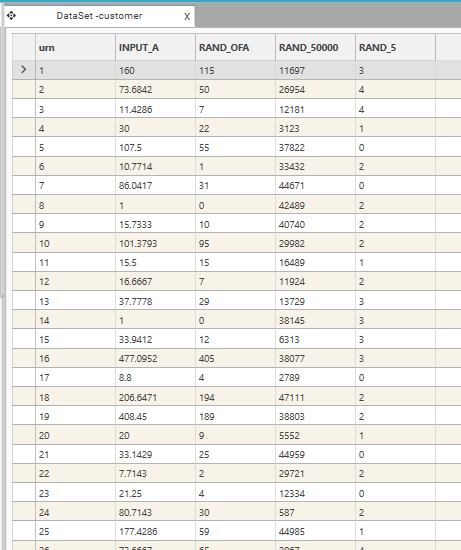
Parameters
| Parameter | JSON | Description |
|---|---|---|
| Table | “targetTable”: “MyTableName” | The target table on which the new field will be created |
| Filter | “dataset”: {DataSet_JSON} | Optional. If a filter is applied, records not in the filter recordset will be returned as null. |
| Math Function | “p1”: “RAND(A)” | RAND(A) |
| A | “p2”: “NumericFieldName” “p2”: “#N*.N*” | Required. Numeric input for Maximum/Minimum value of created data. If A is less than 0, negative values will be created. If A is greater than 0, positive values will be created. Only integer values are returned - If A = 1, then RAND(A) will have a distribution between 0 and 1. Supports:
|
| Treat Null as Zero | "nullIsZero": true "nullIsZero": false | True/False. Default = False If true, then any null values in the input fields will be treated as if they have a value of 0. |
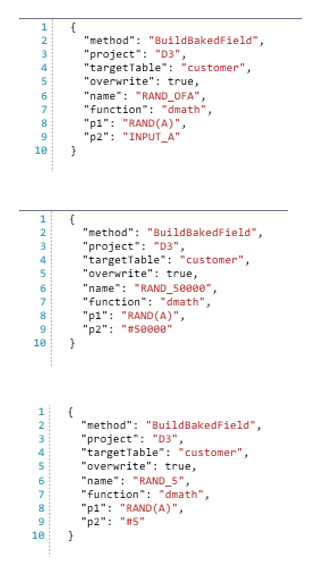
JSON Sample
Usage Notes
See Also:
- DMATH Overview
- Mathematical Expression Field
- NRAND(A) (DMATH)
- BRAND(A) (DMATH)
- ANRAND(A) (DMATH)
- MIN(A+BANRAND(C),D) (DMATH)
- RAND(A) (LMATH)
Example
| Example | Details |
|---|---|
| Description | Create a random distribution that is always between 0 and input A |
| Input |
|
| Sample | 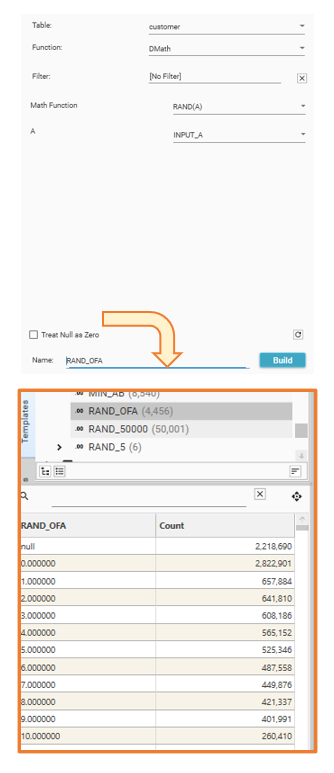 |